Once more to the river

Sam on the St. Croix River, November 2010

Before last Saturday, I had never paddled a canoe in November. But, with Sam in town from Bozeman, MT for a visit, and the forecast calling for sun, we took the opportunity to go canoeing for a few hours on the St. Croix River.

I drove out to Stillwater, stopping at Dunn Bros. for a warm-up of my coffee, and then to Sam’s parents’ house on the North Hill, where he was staying. We then proceeded in a two-car caravan north out of town, gently angling toward the St. Croix.

St. Croix River discharge at St. Croix Falls, Oct-Nov 2010

St. Croix River discharge at St. Croix Falls, Oct-Nov 2010

When we drove down the hill to the landing where we’d leave his car to await our return, the river looked exciting. There was a stiff wind blowing upriver, while the water was still dropping down from recent record high flows and was currently at about 12,000 cfs. Strong current flowing south, strong wind blowing north, standing waves and roiling eddies in the middle of the channel.

We drove another 10 miles upriver and put in at the landing there. Sam is not a frequent canoeist, though an accomplished long-distance backpacker, but he picked up the routine pretty quickly. We were confronted by the wind as soon as we launched and had to push a bit for the first 1,000 yards to where we slipped into a backwater and out of the wind.

Sam at the Osceloa landing

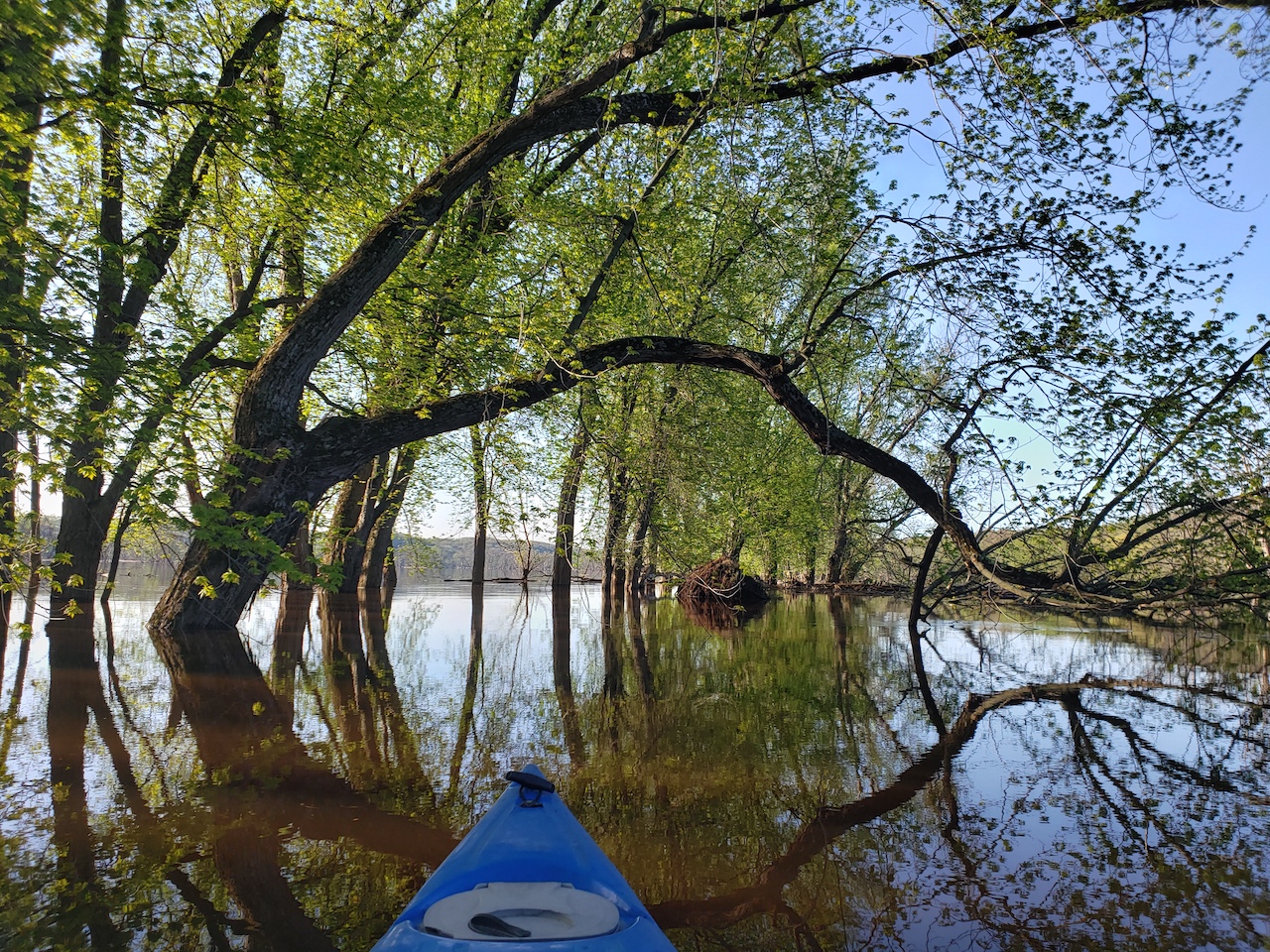
In the backwater, I noticed that flood plain islands I had only seen once before completely covered in water such that a person could paddle through the trees if desired were so flooded this day.

I also noticed a splash of blaze orange back beyond the islands, at the foot of the bluffs, and remembered that the morning was the first of Minnesota’s two-week firearm whitetail deer season. We hoped for sober hunters who didn’t make assumptions about ungulates learning to paddle.

In the wider spots of the channel, we were usually pushed by the wind. We would paddle against it and I kept us close to the bank, often within ten feet, where the waters were calmer. We saw hunters stationed along the banks every couple hundred  yards, but no one else.

After a mile or so of paddling, the wind abated and we stopped our labors and our conversation and drifted downstream for a time in silence. It was a beautiful, wild setting. With the leaves off the trees, you could see into the woods. The tall sandstone bluffs were easy to admire. The occasional stands of white pines, their dark green matching their towering statures, stood in stark relief to the gray and brown of the late autumn forest.

Sam, who has hiked many of the great wilderness areas of the northern Rocky Mountains, later talked of scheduling a trip home next summer to canoe the length of the river.

We passed two hunters sitting in tree stands and then neared a spot where two spring-fed creeks spill into the river, with a flat, wooded point at their outlet that might be the result of thousands of years of sedimentation. There, two deer crashed out of the brush on the bank near us. One was a buck, the other was the doe he was chasing. The buck had a big rack–I couldn’t count the points–and would have been a trophy.

As we rounded the point, we could see another group of hunters, it turned out to be four in total, not 100 yards from the deer. I wondered how the deer had survived the morning. I thought they might have gone up the draw in the bluffs where one of the creeks came down. I also thought such a draw would be a natural ambush point for a smart hunter. But we heard no shots and watched as the group of hunters got back in their boat and motored off, evidently calling it a day.

We stopped from lunch at The Spot, a “secret” campsite featuring a spring-fed creek that tumbles down to the water through a notch in a ridge which otherwise conceals the site from the river. It is named after a similarly excellent backcountry campsite in the mountains near Bozeman.

Sam at lunch

We sat on a flat, grassy spot in the sun. Sam had brought two bottles of New Glarus Spotted Cow which we drank with cheese and venison sticks and toasted our arrival and our departure with a bit of Knob Creek (Sam thus imaginatively dubbing the campsite’s creek “Knob Creek”).

When we pushed off into the river we had one-and-a-half miles of paddling on the wide open river ahead, with that wind still blowing hard. I was feeling the effects of sun and food and beer and whiskey and paddled eagerly. It was good to pull against the water and the wind and to navigate delicately under overhanging trees just along the shore. Hours later, I could still feel the healthy warmth of my windburned cheeks.

Sam and I communicate a fair amount online, whether via Twitter, Facebook, our respective blogs, and instant messaging. I enjoy the photos and other reports from his many weekend and longer adventures in the mountains, and he has shown appreciation for my escapades on his own home river, as he too grew up in Stillwater.

We have often talked about paddling the St. Croix together “someday.” Saturday was that day, and I felt especially positive knowing that now we’ve done it once, we’ll surely travel together again.

Sam standing next to "Knob Creek"

Sam standing next to "Knob Creek"


“Paddle North”

Paddle North coverFor those who love traveling the Boundary Waters region by paddle and portage, the new book titled “Paddle North: Canoeing the Boundary Waters-Quetico Wilderness” from photographer Layne Kennedy and writer Greg Breining from the Minnesota Historical Society Press should be of great interest. I wouldn’t normally engage in such promotion on this site, but I’ve already gladly lent my name to the endeavor, with a short endorsement that appears on the back cover of the book.

“In Paddle North, Greg Breining and Layne Kennedy have captured the beauty, solitude, and challenges of canoe country. They bring to the reader the essence of Quetico-Superior wilderness and remind us of why we go there. Contained in these pages are the roaring silence, the wild lakes, the rewards of canoe travel, and the unique, lifelong memories with friends and family that only a wilderness canoe trip can bring. – Greg Seitz, Friends of the Boundary Waters Wilderness”

One thing people have appreciated about the book so far is that it isn’t just pretty pictures of the scenery (though there’s plenty of those photos, too). There are the muddy portages, the massive wildfires, filtering water, camp kitchens, and the other elements which are just as defining of Boundary Waters travel, but not photographed (and published) as often as the sunsets, cliffs, morning mist, and the such. It’s a wonderful mix between documentary and scenic photography.

Buy a copy via this link, if you’re so inclined, and I’ll get a small cut.

Muddy BWCAW feet


Boundary Waters caught on film

Our friends Jason and Kate took this amusing video of two Pine Martens tussling on their deck outside Ely, MN. Like they asked on their blog, can you watch closely enough to see which one starts in the planter and which one ends up there?

Two videos shot in the Boundary Waters in late September captured the eye of many last week. Filmmaker Alex Horner spent a weekend filming in the BWCAW with his dad and uncle and then worked with his dad when they got back on the music.

It’s like falling asleep and dreaming of canoe country heaven. I love the first rays of morning sunlight hitting the bright yellow birches. And I like pretty much everything else in both videos, too.

I’m pretty sure that when I tweeted the link to part two via my work Twitter account, it ended up making MPR’s News Cut blog:

When I first moved to Minnesota many years ago, an executive (who no longer works in Minnesota) pulled me aside and said, “these people… all they care about is getting through the workweek and getting to their cabin.” He wasn’t from here; he was from New York, where people go to work for entirely different reasons.

At the time I thought — but didn’t say — “so? What’s wrong with that?”


Bridging the past to the future

Map of new Brown's Creek Trail acquisitionWith the announcement that the Minnesota Department of Natural Resources has finally acquired the old Minnesota Zephyr railway line near Stillwater, the popular Gateway State Trail will finally connect to downtown Stillwater. And not only will it be connected, but I would wager that the six new miles of trail will be some of the finest biking and walking in the state.

I’ve been fortunate to walk along those railroad tracks many times. When I was a kid, we’d ride our bikes a mile out Highway 5 to the bridge over Brown’s Creek and then scramble down to the creek and watch trout swim while we played on the limestone rocks along the water. Later, the tracks were a place to wander during high school afternoons. I camped on a friend’s property along the creek often during high school, and still remember quietly walking along the tracks with a few others at dawn, balancing on the rails while the world grew gray in the early part of a summer day.

I digress. It’s a beautiful little canyon, is all I’m trying to say. The ride into Stillwater should be a wonderful, easy gentle downhill, because it slowly but steadily descends toward the St. Croix River from the uplands west of town. I can imagine hardly moving the pedals for much of those six miles.

This wise use of taxpayer money could only be improved one way: by the state somehow including preservation of the old Stone Bridge in their trail plans. The bridge, built in the 1860s as part of the Point Douglas-Superior Military Road and used by Minnesota troops heading off to the Civil War, is just steps away from the rail line the DNR acquired, and would be located about halfway down the new stretch of trail.

The Old Stone Bridge over Brown's Creek near Stillwater, Minnesota

As the oldest standing bridge in Minnesota, the structure is a part of our state’s history. My elementary school was even named after it. It’s privately owned and in need of both serious restoration and maintenance efforts, and broader accessibility to the public. It deserves to be cared for by all of us, and it would be a perfect wayside stop along the new Brown’s Creek Trail. I can already see the bench (maybe even a picnic table!) and the historical marker. While the slight downhill heading into Stillwater will be nice, riders heading the other way would surely love to stop here for a water break, both to drink some and maybe wade in the creek.

The bridge is in need of repair from years of decay, neglect, and vandalism. In 2008, Stillwater Township provided $5,000 to help with restoration efforts, according to a St. Paul Pioneer Press article:

Township residents at their annual meeting Tuesday voted unanimously to contribute $5,000 to preserve the Old Stone Bridge. The limestone bridge dates back to either 1852 or 1863.

“We really, really feel proud of (the bridge),” town supervisor Linda Countryman said. “Citizens are very proud that it is in the township, and it was a very positive meeting as a result.”

The bridge’s owner, Barb Medinger, said last week that the limestone structure is crumbling and in desperate need of repair.

Trees are growing out of both ends of the bridge, and part of it has been washed away by Brown’s Creek trout stream below. Kids shooting off M-80s damaged it last Fourth of July, she said.

“It’s eroding, and vandals have been compromising it by pulling out the stones,” she said.

The new bike trail is going to be terrific. Now I just hope some folks at the Minnesota or Washington County Historical Societies, the DNR, or another entity, particularly one with access to funds from the Clean Water, Land and Legacy Amendment, figures out a way to preserve the bridge ($54.5 million of the tax money in FY 2011 is dedicated for arts, arts education, and arts access, and to preserve Minnesota’s history and cultural heritage). It might not have to be through outright state ownership, but something must be possible.

I visit the bridge at least a few times a year. It’s a peaceful place, with the clear water of Brown’s Creek pooling up before rushing through the cataract of the bridge and then down the shady canyon toward the river. Dogs love to splash in that pool. The bridge feels like a gift from the past, a modern American ruin. It ought to be saved before it’s just a pile of limestone rapidly washing away in the waters of the creek.

Old Stone Bridge, photo circa 1940, Minnesota Historical Society

Photo circa 1940, Minnesota Historical Society


The Firegrate Review

Firegrate Review logoThose who know me and know my work probably weren’t surprised when the Friends of the Boundary Waters Wilderness announced that we’ll be publishing a chapbook this fall. It’s a special project of mine and I would love it if some of my BWCAW-loving readers sent in an essay, poem, or other writing of some sort.

We are seeking submissions from anyone who loves canoe country. Unfortunately, we don’t have the funds to offer monetary awards this year, but I hope writers might see it as a way of supporting a worthy cause and a chance to get their words in print in front of an audience of people who care deeply about the Boundary Waters.

The deadline is September 30. Click here for details and to submit your stuff!

Also, Katie and I had a great five-day trip to the Boundary Waters over Labor Day weekend. We took a lot of photos and I really do want to post a full trip report with pictures… But I have a feeling that’s going to take a while. Here’s one photo:

Mist and islands on a BWCAW lake.

Morning on South Wilder Lake... which we had all to ourselves. It was a place of intense solitude and roaring silence, quiet save the occasional red squirrel chattering from the woods or crow caw-cawing as it flew across the water. We were more than a mile from the nearest human, and about 10 miles of paddling and several portages from the nearest road.


Page 6 of 27« First...45678...20...Last »