How far we’ve come

Dawes illustration from Daytrotter

Dawes, who I wrote about seeing last Friday at Taste of Minnesota, has been featured by music website Daytrotter. The four live tunes are unsurprisingly excellent, but the stream-of-consciousness essay about the band, its music, and life by Sean Moeller that accompanies the music is worth the visit alone:

“Since we first met the four men in Dawes a year and a half ago, we’ve spent a lot of time with them. We’ve spent days with them in barns, freezing all of our asses off, drinking lots of whiskey, hot apple cider and hot chocolate. We’ve seen them hop out into the yard and chase around barnyard animals, squawking and fussing to get out of the way. We’ve seen them get very little sleep and spend every waking hour singing and playing, just spilling with what they have running through them. We’ve spent a 4th of July with them, standing beneath a menacing purple-black sky full of storm clouds, rain and a couple hundred dollars worth of illegal fireworks. There have been babies in our families named after them. We’ve talked to them for hours until our throats were raw with the task and the effort, turned husky but still happy to have done it. We’ve come to love them as brothers and yet, through all of it, what still remains untouched is their ability to make us gasp with the purity of what they do and who they are as a group of musicians. Even a close friendship doesn’t dull one’s sense of awe when it comes to their debut album “North Hills,” a live show that’s absolutely a religious experience and new songs that are just as good and scarily meaningful. They never cease to make us stop and account for our own deficiencies – not in a destructive way, but in a way that forces us to be closer to ourselves and those that we tell ourselves we loved and are told that we’re loved by…”

Keep reading: Dawes: Daytrotter Session recorded Jul 8, 2010.


Seize the carp

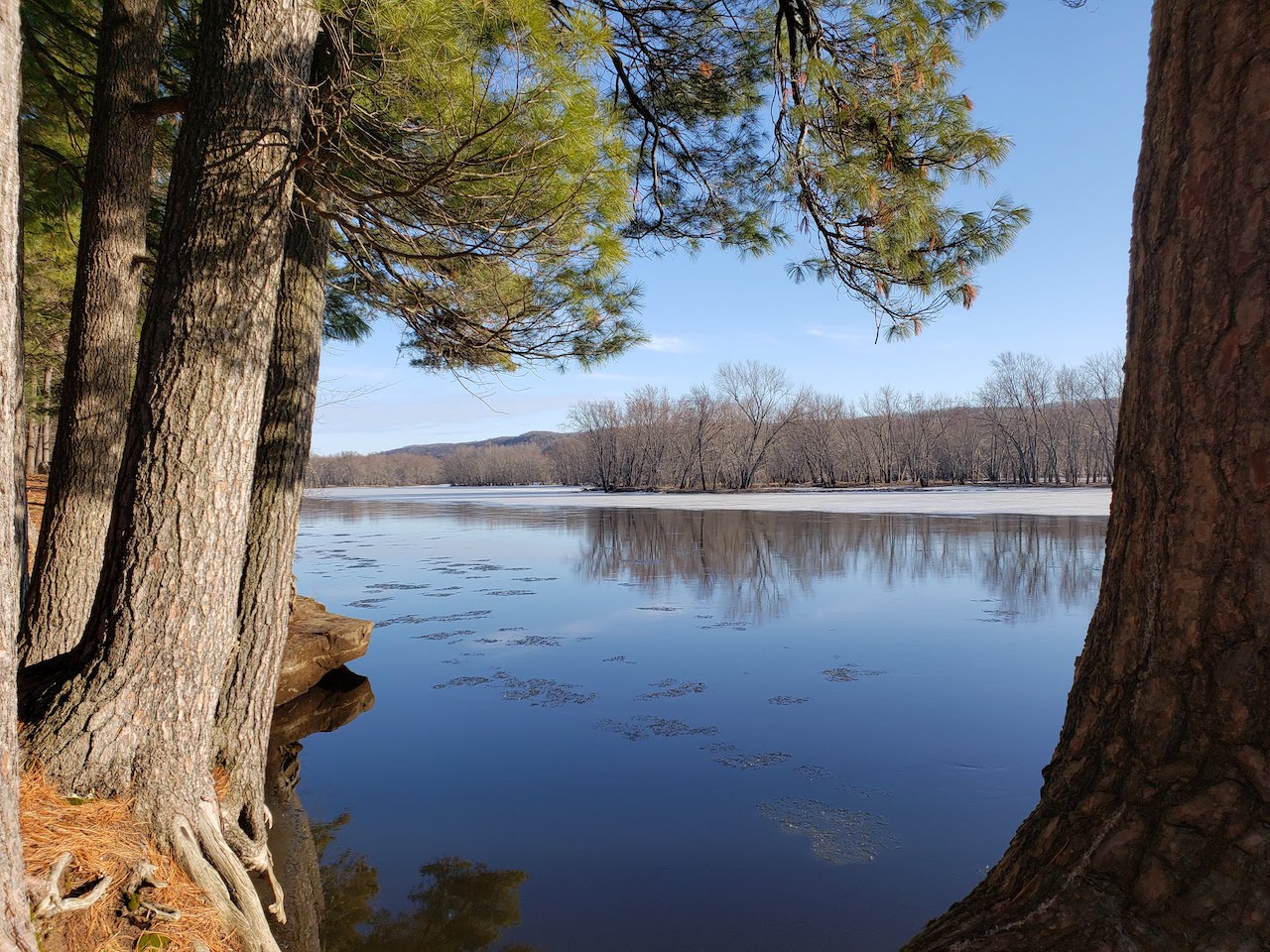
White mist, white pines on the St. Croix River

About the same time Gabe arrived at the house to go fishing on Monday, the rain came back in a big way. A strong storm had come through earlier in the afternoon, but was followed by sun breaking through clouds. Now, though, it was falling again, seemingly harder than gravity could be responsible for, perhaps somehow projected down from the heavens.

Gabe dashed in the front door from his car and we stared out at where the canoe was sitting on the grass of the front lawn, just needing 10 minutes of work to get it on top of my car. We finally went to look at the weather radar on the computer–which told us it was raining and would be for a while–and when we returned to the front door, it had subsided.

We donned rain jackets and went out to strap the Wenonah on the car. The theory was that the showers would be sporadic and, on a warm day like this, not worth discouraging a fishing trip.

Driving east on Highway 36 the skies really let loose and we laughed a little bit about the fact that we were driving through such weather with a canoe on the car and fish swimming in our minds. But, we figured we’d get near the river and wait for it to let up. If it didn’t? Well… it had to.

Paddling down the rainy river

The skies weren’t giving up any helpful information as we approached the landing and when we pulled up to the river it was still coming down good, but by that time we’d driven all the way out there so what the heck, let’s go. We paddled away from shore with our hoods up and our hats pulled down and some rocky shoreline on the opposite bank in our sights.

I should say that perhaps only I had the rocky shoreline in my sights. Rocks generally mean smallmouth bass, which I was itching to target with a new Sage 8-weight fly rod. My paddling and fishing partner, on the other hand, has recently been smitten with fly fishing for carp (of all things!) and wanted to return to a mud flat upriver where a big one had snapped him off the day before. But first we casted at the rocky shoreline.

It was good we didn’t venture far from the landing, because almost imperceptibly, the rain stopped, the skies brightened, and I realized I had forgotten my sunglasses in the car. The oversight was understandable, considering the weather we had launched in.

After stopping to pick up the sunglasses, we struck off upstream. The water was high from a wet series of weeks, but the current was manageable. We dug in a bit and made it up to the first bend, where on the outside a bunch of snags against the bank usually hold some fish.

Summer bluffs

We took turns casting toward shore and the fish were willing if not enthusiastic. I was in the stern and, as much as I love the pull of a smallmouth on the line, I was enjoying just as much maneuvering the canoe while Gabe casted. I’ve been sitting in the stern of that boat for about five years now and I really love it. At seventeen feet, with 1 1/2″ of rocker and a nice wide beam, it’s proven itself as a great St. Croix craft. It turns sharply but it tracks well enough, and it’s stable enough for steady Gabe to stand in the bow and cast, or for our oblivious dog to shift her weight suddenly without putting all of us in the water.

The river was absolutely calm. The water was like glass, and white mist was rising, seeming to get held up on the white pines which towered over the other trees on the bluffs. It was evening now after a long and busy holiday weekend. Occasional canoes, kayaks, and pontoon boats passed by quietly, the stragglers of what had surely been a steady stream of people enjoying this gorgeous river all weekend long.

I continued seeing what I could do with my paddle. A draw there, a stroke here, and a canoe can move and turn all at once, in any possible direction. When you start to know how the paddle and the boat interact, it seems like you can move across the water on the power of thought. If you’re targeting spooky fish, or slipping through a narrow, twisting channel, a cooperative canoe becomes your dear friend and ally.

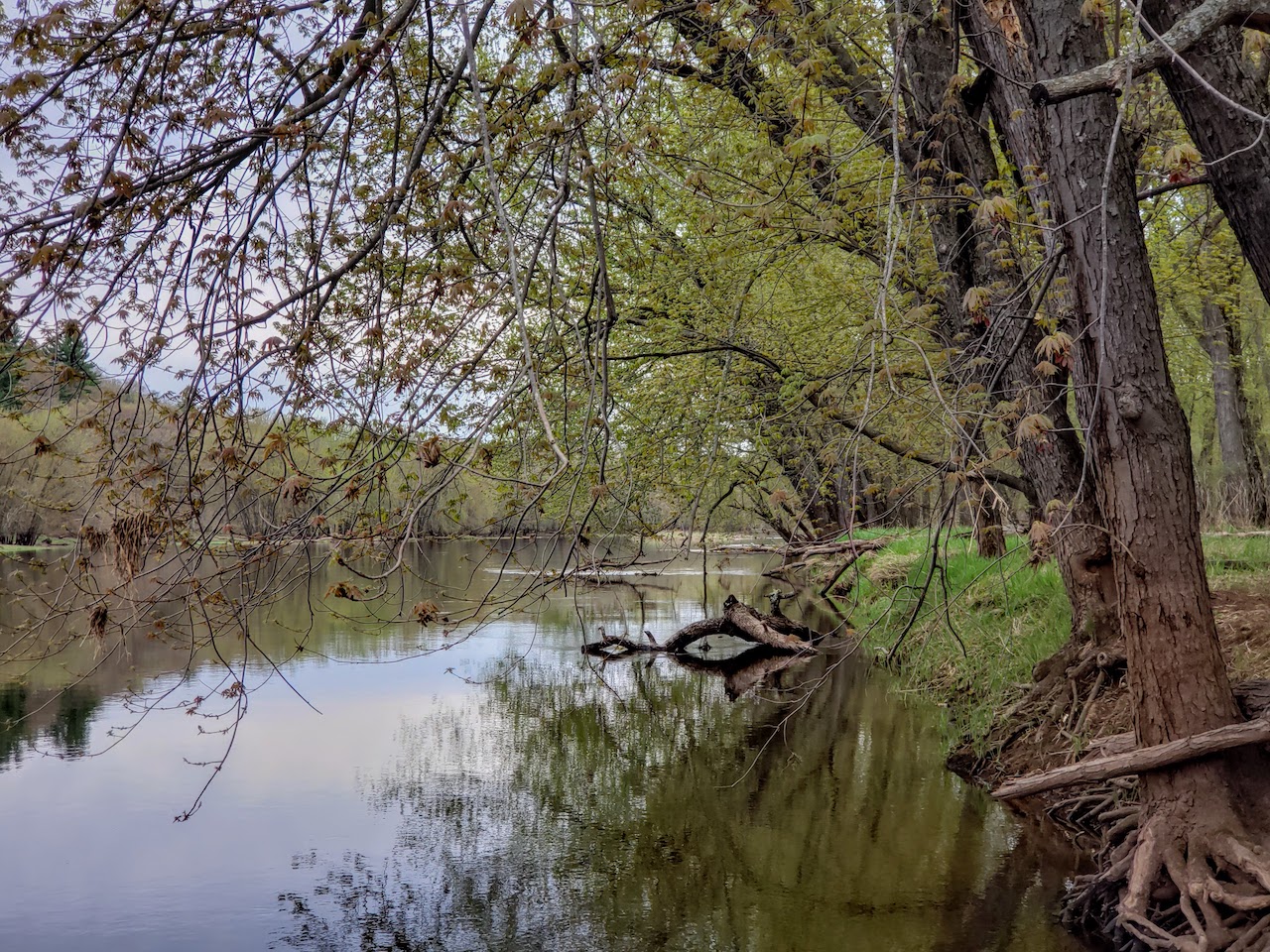
Rainy river

Carp were still on Gabe’s mind, so we headed up a back channel that entered the river here. Ahead were broad, shallow silt flats ringed by grasses and other water plants.

As we eased the canoe up the channel, big swirls started to appear at the edges of the open areas. Reeds and grasses were sent swinging back and forth as unseen creatures below the surface rooted around at their bases.

I gently pushed the canoe along while Gabe stood in the bow and looked for fish. If not the nudging of weeds, they would be revealed by a steady line of little bubbles on the surface that were sent up by feeding fish. When he spotted a target, he would send long, precise casts across the water to a spot just a few feet away from the target. Slowly he would twitch it a few times. Nothing happened.

We continued on exploring the backwater. Red-winged blackbirds perched swaying on tall grasses; a mature and immature bald eagle screeched back and forth at each other as we approached, stopped crying when we stopped approaching, and then flew off in separate directions. A tiny bird dive-bombed the immature bird its whole way across to the next stand of trees.

My carp-targeting friend continued to stalk the fish; he even got two brief takes. But the fish seemed to sense our very presence as we approached. I was taken again with how quiet a canoe can move through calm water. There seemed to be no resistance to our passage.

The day began to dwindle and in the morning it would be time to return to work after four days away. We set off up the channel, seeking its upstream connection to the main river. We found it but of course the entrance was blocked by a big snag. We precariously pulled the canoe over the big trees and then paddled out into the main channel, where we headed back down toward the landing.


Peace in the valley

There’s a river running through the city
Gently reminding me what’s what.

- Dawes, When You Call My Name

Dawes at Taste of Minnesota, St. Paul, Minnesota July 2, 2010I’m heading out fishing in a short while, whenever Gabe gets here. The river is up high from a wet stretch of weeks and in fact the tornado sirens reportedly went off briefly out in Stillwater an hour ago when a fierce line of storms blew across eastern Minnesota. I swam in the St. Croix yesterday, no better way to beat the heat on such a muggy day. I want to get back in it today, though I’m afraid I may be confined to the canoe with the good beaches all underwater.

This is the first weekend in perhaps a month in which obligations have been outnumbered by unplanned hours. It was a busy June and I just need to accept it and acknowledge that the commitments were positive: a wedding in Portland, my mom’s retirement party, a successful canoe trip with journalists for work.

Katie and I took Friday afternoon off work to go to the Taste of Minnesota where we saw Retribution Gospel Choir and Dawes play. We wanted to stick around for the evening when Minneapolis hip-hop stars Atmosphere and P.O.S. were playing, but we had a sick dog that we didn’t want to leave at home too long.

The two bands we did see were worth the vacation time, the ticket price, and any effort of getting ourselves to Harriet Island. Retribution Gospel Choir (featuring Alan Sparhawk [and Steve Garrington] of Duluth band Low) was typically face-melting, as the kids say. Melody climbing out from under noise, masterful guitar work, chaos coalescing into harmony. It was an atypical venue, a tent at a family-friendly event on a Friday afternoon before a holiday weekend. When we arrived, folk-country singer Justin Townes Earle (son of Steve Earle, named after Townes van Zandt) had recently finished, and the seats were full of middle-aged couples and others who didn’t look much like the crowd the last time we saw RGC at the Triple Rock Social Club on Minneapolis’s West Bank.

It felt strange to sit down and take in a show by a rock band like them, but I honestly couldn’t complain. We scored a couple chairs at a table and I drank my Summit EPA and enjoyed the craftsmanship–even though I’m not sure everyone else did; several folks found it not to their liking and excused themselves from the tent.

We went right up to the front for Dawes and I don’t think many people stayed sitting. The band from Los Angeles’s Laurel Canyon then proceeded to defy my expectations. As most good electric alt-country-folk-rock acts do, they turned up the volume from their album recording (“North Hills”) and really put on a show. The crowd returned the favor.

The guys in the band seemed genuinely blown away by the audience reception–wild cheering and big smiles. They even played an obviously unplanned encore, which is really the only good kind of encore. We got our hands on a vinyl copy of the record afterward and shook hands with the lead singer, who enthusiastically autographed it.

If I don’t find peace in the valley
I’ve got no place else to look.

- Dawes, Peace in the Valley


A watery embrace

Fighting a fish on the upper St. Croix River

The wildness, beauty and joy of the upper St. Croix River really shines through in this piece from the Milwaukee Journal-Sentinel by Paul Smith, the paper’s outdoors editor.

We push off and begin a leisurely trip down the river. The banks are lined with alders, white cedar and an occasional white pine; the water is pocked with gray boulders.

The river here is Class 1, meaning “no worries.” Bartz paddles solo, Zeug and I share a canoe. We dwell around the deeper holes, casting with floating crank baits and soft plastics.

When the canoe scrapes bottom, we get out and pull. The water is 70 degrees Fahrenheit, a near match for the air.

“I think I’ll just stand here for a while,” says Zeug, standing calf-deep in a gurgling, natural Jacuzzi.

He wouldn’t have to move because of river traffic or bank-side voyeurs: over five hours, we don’t see another human being.

The description of their stop for lunch, which closes the article, is alone worth the read.


The pleasure of the story

Being Wrong book coverIt’s possible that everything you’ll ever need to know about storytelling is contained in this interview with Ira Glass of the radio show This American Life. The interviewer recently published a book about being wrong (Being Wrong: Adventures in the Margin of Error), and Glass seems to be the perfect subject.

An astute commenter on the interview points out that the idea that most modern literature is about wrongness (not to mention Shakespeare, Greek tragedies, and the Old Testatment) is not a new one.

Nonetheless, Ira Glass breathes life into the matter like no one else.

Do you consciously think about wrongness as a narrative device?

I don’t go looking for stories with the idea of wrongness in my head, no. But the fact is, a lot of great stories hinge on people being wrong. In fact, we’ve talked as a staff about how the crypto-theme of every one of our shows is: “I thought it would work out this way, but then it worked out that way.”

Sometimes that wrongness exists in really small ways. We did a story this week about a man who saves people on a bridge in China. It was kind of a radio cover version of a magazine piece by a guy named Mike Paterniti, who started out thinking the man was going to be this inspirational Gandhi-like figure. And then Mike gets there and the guy turns out to be totally gruff and barely talks to him. That’s a small wrongness, but it’s the pleasure of the story. If you just showed up at the bridge without the setup of thinking he’s going to be a great guyif he just starts off as a grumpit’s less pleasurable. It’s less fun. The collision of reality against expectation is what makes it work.

Why is there such a big payoff for the listener in stories about wrongness? What makes it so pleasurable?

Well, if the story works, you become the character, right? You agree with their early point of view, and then when it gets shattered, you are shattered with it. So in the storytelling, you want to manipulate the evidence and the feelings so that the audience is right there agreeing with the person who’s about to be proven wrong. When that happens, if it’s done right, you as the audience get flipped upside down.

Later, the interview explores the subject of Glass being wrong in his own work and life. Glass talks about going into a story thinking it will be great and finding out it doesn’t work (which seems to happen more often than not), and dismissing story ideas that later make award-winning radio. He also recalls committing a lewd act as a junior high boy that is so embarrassing to even think about that he can barely force himself to share it.

But he does share it. The successful and ground-breaking radioman doesn’t try to make himself look better, but rather seems to find interest and joy in his own wrongness, just like he does when producing a radio story. Which makes sense in the context of another excerpt from the piece:

There are definitely lots of things that I don’t want to be wrong about and will fight to the death over, and I’m totally obnoxious about it all the time. But I also feel like there’s a kind of discovery that you’re wrong that, in a safe situation, can be a real pleasure. Do you know what I mean? Like when you’re arguing with someone you love and you realize, “I’m wrong, you’re right,” and you come together in that moment. It’s such a relief. To me it’s so obvious that some kinds of being wrong are OK.

Read the whole thing, it’s worth it.


Page 8 of 27« First...678910...20...Last »